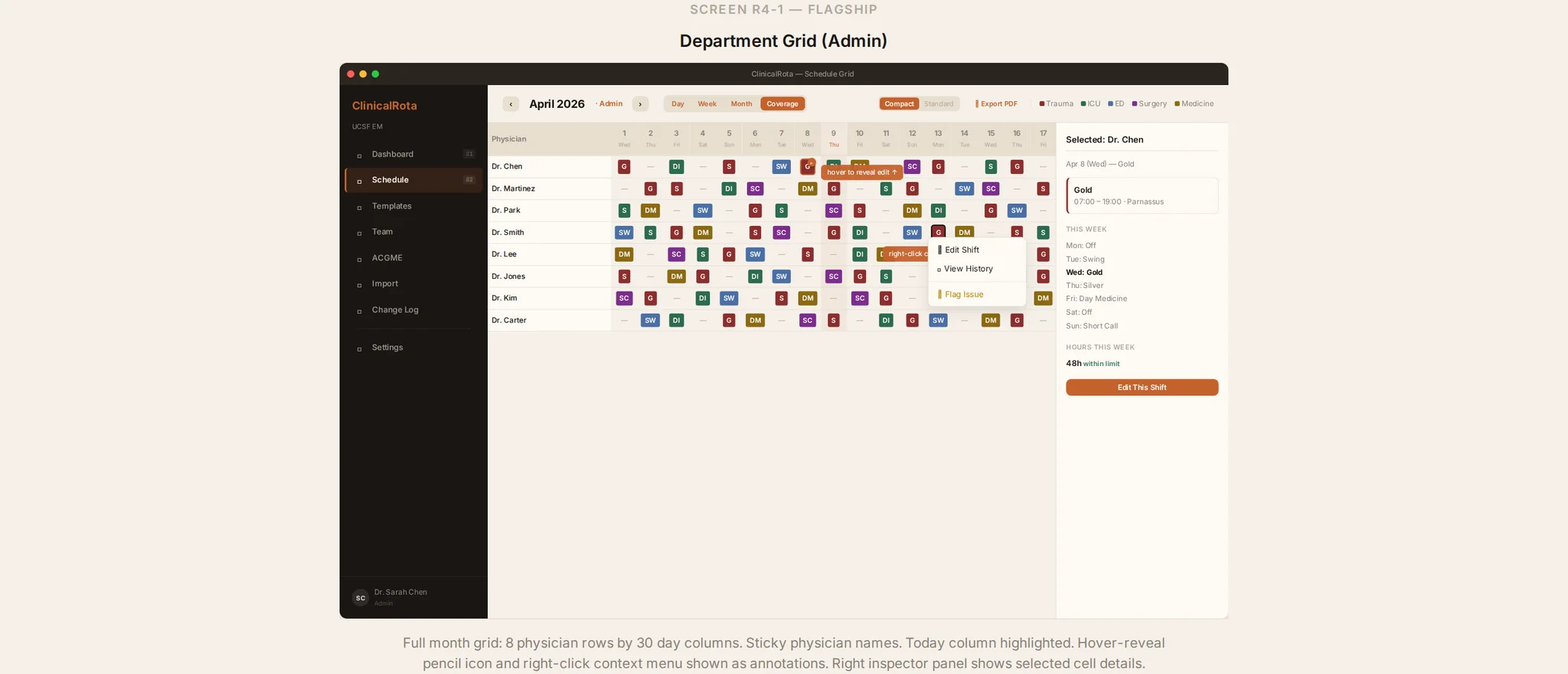
On-call scheduling gets ugly when the rules are implicit.
That is the simplest way to say it.
Most departments think they have an on-call system. What they often have is a draft roster plus a collection of unwritten exceptions that live in the scheduler’s memory.
The First Rule Is To Write The Real Rules Down
This sounds obvious until you watch how many schedules are built from folklore.
Who can cover which service? Which call combinations are technically allowed but operationally reckless? What rest matters in practice, not just in policy? Which backup situations are acceptable on paper but not in the real world?
If the answer depends on who you ask, then the rule is not actually encoded yet.
Fairness Needs To Be Inspectable
Counting total call shifts is not enough. The hard part of on-call scheduling is that not all call burden feels the same.
Holiday weekends feel different from ordinary weekdays. Trauma backup feels different from lower-acuity backup. A call shift attached to a clinic day is different from one attached to a lighter service.
People do not need the schedule to be perfect. They do need to believe the burden is being shared honestly.
Preference Collection Should Not Be A Social Contest
A lot of scheduling conflict is caused upstream. Requests arrive through different channels, at different times, with different levels of insistence. By the time the draft appears, the process already feels arbitrary.
This is one of those problems that looks interpersonal but is mostly structural. One channel. One timeline. One visible process. That alone removes a lot of friction.
Change Handling Is The Real Test
The published schedule is only the beginning. The real test is what happens when someone cannot take call.
If the department falls back to ad hoc texting, private favors, and frantic coordinator outreach every time reality changes, then the system was never finished. It was only temporarily quiet.
Good on-call workflows decide this part in advance. What counts as a swap. What counts as emergency coverage. Who has authority. How the change is recorded. How the rest of the team finds out.
The Better Standard
The standard for a good on-call schedule is not that it can be produced.
Most departments can eventually produce one.
The standard is that the schedule remains intelligible when challenged and remains workable when the first disruption hits. That is the bar that matters.
If your on-call process depends too much on memory, side agreements, and heroic coordinators, see the sneak peek. We will walk through the current direction, learn which part of your workflow is actually breaking first, and decide what the first version should do.