Most writing about AI scheduling makes the same mistake. It treats scheduling as if it were one problem.
It is not.
Part of scheduling is computational. Part of it is social. Part of it is political. Part of it is institutional memory. If you do not separate those parts, you end up asking AI to do work that is not really mathematical at all.
What AI Is Good At
AI is useful when the hard part is sorting through too many possibilities.
That includes things like:
- turning messy inputs into something structured
- surfacing obvious conflicts
- exploring possible assignments under a clear set of rules
- making it faster to answer questions like who is on, who is qualified, and what changed
Those are real gains. Hospitals generate a lot of clerical scheduling work that software should be able to reduce.
What AI Is Bad At
AI is much worse at the parts people actually argue about.
Should this person get the next holiday off because they covered the last one, or because they have two children, or because morale is already fragile? Should continuity matter more than equal night distribution for this service? Is a rule really a rule, or just a habit one coordinator has been enforcing for years?
Those are not optimization problems in the clean sense. They are judgment problems. They require context, trust, and often an accountable human being.
This is why a lot of “AI scheduling” talk feels slippery. The useful part is real. The grander claim is usually not.
The Real Bottleneck Is Usually Earlier
Before a hospital can benefit from better automation, it usually has to answer some less glamorous questions.
What is the schedule source of truth? Which rules are explicit and which live in memory? What counts as fairness? Which changes need approval and which should happen automatically? What data is actually reliable enough to use?
If those questions are unresolved, smarter software just makes the confusion faster.
The Better Way To Think About It
The right model for AI in scheduling is probably not autopilot. It is more like a very fast assistant.
It can help turn ugly inputs into clean ones. It can point at inconsistencies. It can generate options. It can make the state of the schedule easier to inspect.
But it should not pretend to own the final judgment. A hospital schedule is too entangled with safety, fairness, and institutional politics for that.
How We Think About It
Clinical Rota is early, which is useful here because it keeps the conversation honest.
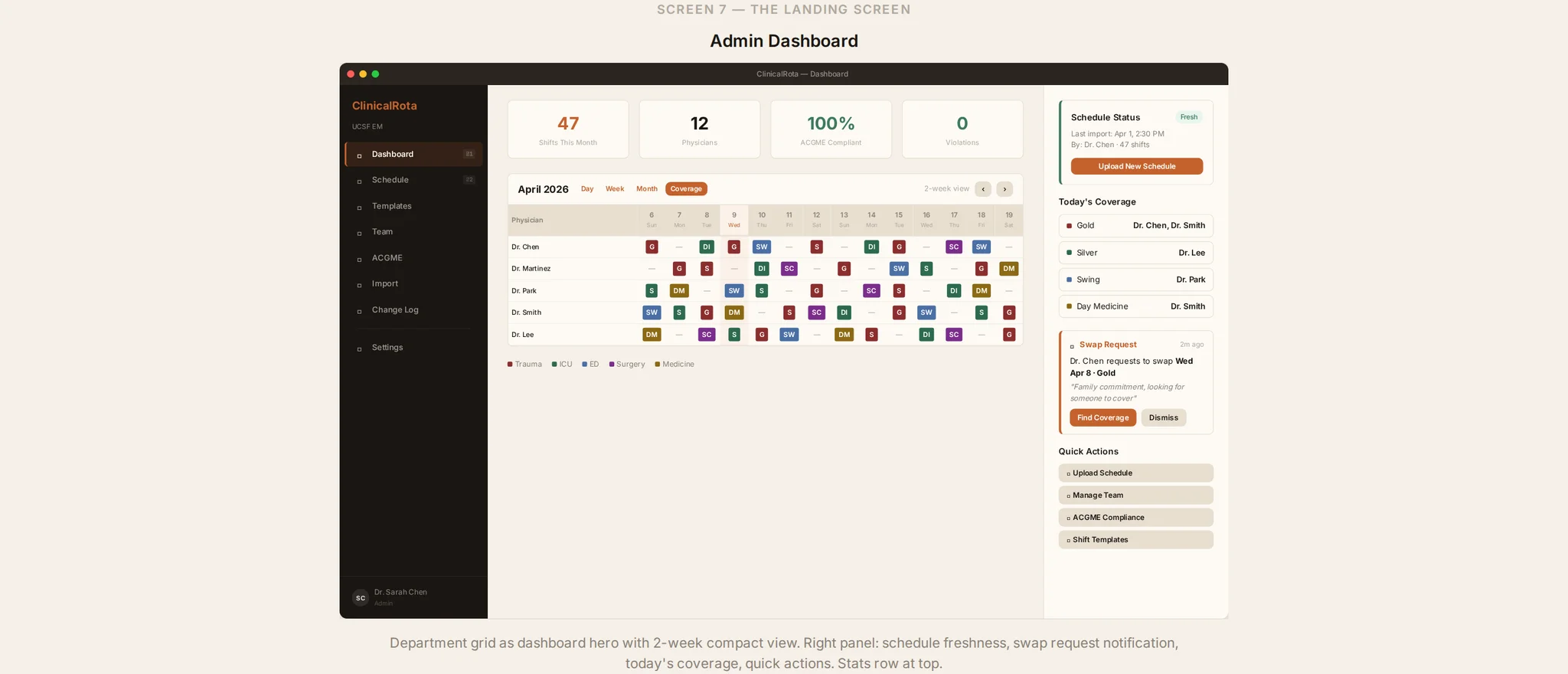
We are not trying to claim that AI will solve healthcare staffing by itself. We are interested in narrower questions. Can software make the schedule easier to read? Can it make hidden tradeoffs visible? Can it reduce the amount of coordinator labor spent reconstructing what changed and why?
Those questions are smaller. They are also more real.
If this is the problem you want solved, see the sneak peek. We will walk through the current direction, learn where your current workflow breaks, and decide what the first version should do.